Toch maar eens mijn review plaatsen.
An album that needs a 16-page booklet to explain what's going on. That's something to expect when you get the new album by Florian Hecker. After 6 years of silence in the releasing schedule finally Acid in the style of David Tudor sees the light.
In the title we see a reference to both modern 20th century composing and modern rave culture. How this would be combined is actually the question, which is partly explained in the essay in the booklet, though most people probably never reach this far with reading, because they already stop after the first paragraph.
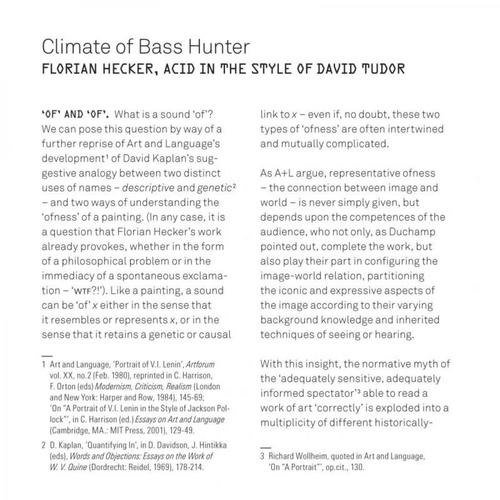
In the essay Climate of Bass Hunter: Florian Hecker, acid in the style of David Tudor the academic writer Robin Mackay gives a brief history of analogue electronic instruments with not too much in-depth information to understand it as an outsider. Though, at the point where he starts about the Roland 303 and modern rave music things become quite clear.
After this he goes to describe the approach that Florian Hecker has on music, which can be summarized as "as variable as weather change".
While referring to the modern composer David Tudor he tries to explain what Florian Heckers take on the rave music will be, while not drifting away from his usual approach to music.
When you are not from the academic music scene too much questions remain unanswered. They did try to explain things, but in my opinion fail quite a bit.
On to the music, because that is eventually the part where it really gets interesting.
The album contains 10 pieces of music divided in three different sections. There are 6 pieces called Acid In The Style Of David Tudor, 3 pieces called ASA and the last piece is called Ten.
The Acid pieces contain of recordings from the combined Buchla modular synthesizer and Comdyna analog computer. These pieces come soundwise closest to acid because of the analogue sound to the sounds. But in style it is indeed like David Tudor and the other modern composers. In a chaotic way the sounds shift from left to right and back, spinning around the whole room. Randomized notes blast from the speakers threatening like to become an aural assault, which they eventually become.
When played at proper volume (that's pretty much LOUD) the sounds start to mingle with your mind and concentration.
Real speaker testers this, just like his live performances.
The ASA pieces are in the mind fuck business even worse. High pitched tones pierce your skull. Hecker makes use of only one channel in this case, either the left or else the right, drifting between two near frequencies. Because of this you get a binaural effect. where while sounds come from just one side you still hear a stereo effect (at least when played on speakers.
These pieces remind me a lot of the work done by Asmus Tietchens on his menge series, though it's even harsher.
The last piece Ten starts with high pitched tones also, but this time as stereo sound. The sounds again take all your concentration away, but everything is more timid. What this piece does, though, is more based on the position you are compared to the speaker system. The sounds are built in such way that when you move through the room the sounds change from place to place (or am I just imagining this).
Again the stereo spectrum is used to reach the goal.
Acid in the style of David Tudor is an album that is searching for boundaries hearing. It asks a lot from the listener but if one is open for this you can gain quite an experience from this music. Though, at points it all becomes slightly too academic, this might turn off quite some listeners. This will definitely happen with the booklet also. It almost becomes academic music for academic musicians and not music for the regular listener.
My recommendation is to go see Hecker live and after this listen to this album to slightly relive the experience you had during his performance.