Vandaag leerde ik dat John Peel destijds het gehele album abusievelijk achterstevoren heeft afgespeeld, live op BBC Radio 1

The infamous incident in which John Peel accidentally played Robert Fripp and Brian Eno’s full album backwards on the radio.
John Peel’s Radio 1 Show, Top Gear: 18 December 1973
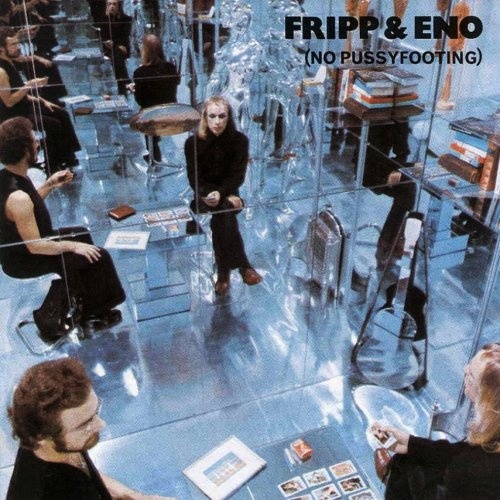
Robert Fripp of King Crimson has made an album with Eno, the ostentatious synthesizer player in Roxy Music, who was sacked in the summer after a personality clash with Bryan Ferry. (No Pussyfooting) is an experiment in sound collages, looped guitars, tape delay and dreamlike drones. Peel admires the way Fripp and Eno approach their music—semi-cerebrally, semi-mischievously—and has been a supporter of King Crimson since putting them on the radio for the first time in May 1969. How long ago it now seems since January 1972, when he did the same for Roxy.
The copy of (No Pussyfooting) that Fripp and Eno have sent Peel is, for some reason, in the form of reel-to-reel tape rather than vinyl. The tape has been stored 'tails out' on the take-up reel, in accordance with Fripp and Eno's standard practice, meaning that the tape must be rewound to the start in order that it can be played. At the BBC, however, storing tape ‘tails out’ is not standard practice. Somebody on the Top Gear production team misinterprets what he’s looking at and reverses the reels instead.
Eno listening to Peel at home, is the first to notice that the album’s opening track, ‘The Heavenly Music Corporation,’ is being played backwards. He hurriedly phones the BBC and demands to be put through to Peel’s studio. The Broadcasting House receptionist, taking exception to Eno’s tone, hangs up on him. The entire twenty-one minutes of ‘The Heavenly Music Corporation’ go out over the air backwards without Peel, [his producer John] Walters or anyone else spotting the mistake.
An hour later...Peel introduces the second track by Fripp and Eno, ‘Swastika Girls,’ which—again—he plays backwards for its complete eighteen-minute duration. ‘I’d like to see what they made of that on Come Dancing,’ he chortles after it ends. Having made Radio 1 history by becoming the first DJ to play an album back to front, he wholeheartedly recommends it to the listeners (’Magnificent...well worth having’) and compares it favourably to the recent work of Tangerine Dream.
Fripp and Eno can be impish and playful, but (No Pussyfooting) is not a prank. It’s a bold artistic statement made by two musicians who overrode the objections of their management and fought their corner to have the album released. Fripp will later recall ‘getting a sheet of white paper at AIR studios, writing “No pussyfooting” and putting in on the mixing console to remind us not to allow this music to be undermined.’ In the ambient and electronic fields, (No Pussyfooting) is near unanimously agreed to be a groundbreaking work.
But there’s no getting away from the fact that most listeners in Britain who heard (No Pussyfooting) in 1973 heard it backwards. And it’s a testament to Peel’s single-mindedness as a broadcaster that, whereas more conservative DJs like Bob Harris or Alan Black might have settled for playing a two-minute extract of it backwards, Peel had the courage to play the album backwards in full. Thus are men separated from boys. In a fitting postscript to the story that sadly came too late for Peel to appreciate, his backwards versions were included as bonus tracks when a 35th anniversary of (No Pussyfooting) was released in 2008. Both were given a twenty-four-bit digital remaster by Fripp.
Bron: Good Night and Good Riddance: How Thirty-Five Years of John Peel Helped to Shape Modern Life by David Cavanagh